How to Improve Your Visualisation Skills for the NID Studio Test and NIFT Situation Test
Visualisation is one of the most important yet least understood skills tested in both the NID Studio Test and the NIFT Situation Test. Many students assume visualisation simply means drawing better. In reality, visualisation is about mentally imagining situations, systems, and outcomes — and then communicating them clearly.
Both NID and NIFT use visualisation tasks to understand how a student thinks before they act. They are not looking for perfect drawings; they are looking for clarity of thought, logic, and intent.
Understand What “Visualisation” Really Means in These Tests
In the context of NID and NIFT, visualisation means:
- Imagining a situation before it exists
- Predicting how people will interact with a space or product
- Translating an abstract idea into a visual form
- Showing process, not just a final result
For example, if the task is to design something for a public space, the examiner wants to see:
- Who is using it
- Where it is being used
- What problem it solves
- How the situation changes after your intervention
Your drawings support this thinking — they don’t replace it.
Practise Thinking in Scenarios, Not Objects
One of the biggest mistakes students make is drawing objects in isolation. Design exams rarely ask for that.
To improve visualisation:
- Practise imagining real-life situations
- Ask “what is happening here?” before drawing
- Think in terms of before, during, and after
Example practice:
- A crowded bus stop → what problems exist?
- A school corridor during recess → how do students move?
- A public park in the evening → who uses it and how?
Then sketch the situation, not just the product.
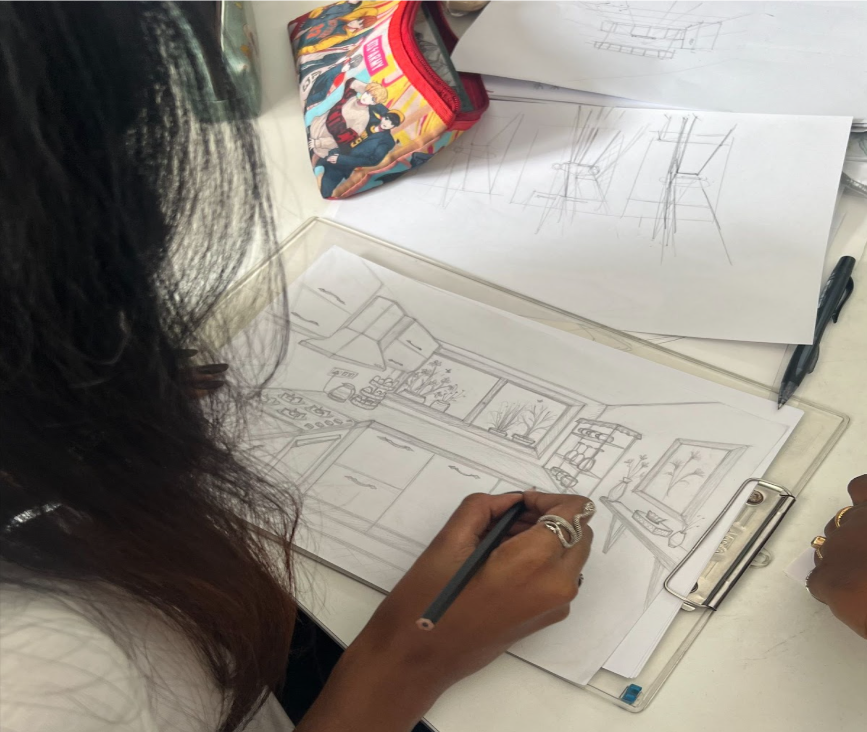
Use Sequence Drawings Instead of Single Sketches
Both NID and NIFT value process-oriented thinking. A single sketch often cannot explain a complex idea.
Train yourself to:
- Break ideas into steps
- Use multiple small frames
- Show progression or transformation
Sequence sketches help examiners quickly understand:
- How your idea works
- Why it exists
- What changes it brings
This is especially important in the NIFT Situation Test, where clarity and organisation matter a lot.
Related: How to Prepare for Sketching, Visualisation, Doodling, and Rapid Sketching for the NID Studio Test
Strengthen Your Ability to Visualise Human Interaction
Human presence is central to visualisation. Even a rough human figure adds context and scale.
To practise:
- Draw stick or gesture figures interacting with objects
- Focus on posture and action, not anatomy
- Show hands, movement, and direction
Ask yourself:
- Who is using this?
- How are they using it?
- What emotion or challenge do they have?
Human-centred sketches immediately improve visual clarity.
Practise Mental Rotation and Perspective
Visualisation also includes the ability to imagine objects from different angles.
Exercises to improve this:
- Pick an everyday object and sketch it from three viewpoints
- Visualise how it looks when opened, folded, or moved
- Practise basic perspective without over-detailing
This helps in tasks where you need to explain form, structure, or space.
Translate Words into Visual Ideas Daily
Both exams often give verbal prompts that need to be converted into visual solutions.
To practise:
- Take a sentence from a newspaper or signboard
- Imagine it as a visual story
- Sketch how that idea might appear in real life
This builds confidence in handling abstract prompts — a common challenge in the Studio and Situation Tests.
Use Annotations to Support Visualisation
Visualisation is not just drawing. Short annotations strengthen communication.
Practise adding:
- Labels
- Arrows
- One-line explanations
These guide the examiner’s eye and reduce confusion. Good visualisation always makes the examiner’s job easier.
Practise Under Time Constraints
Visualisation must happen quickly in the actual test.
Train yourself by:
- Limiting thinking time
- Sketching immediately after understanding the problem
- Avoiding overthinking or restarting repeatedly
Speed improves when clarity improves — not the other way around.
Learn to Evaluate Your Own Visuals
After each practice session, ask:
- Can someone else understand this without explanation?
- Does the sketch answer the problem clearly?
- Have I shown context and use?
Self-evaluation builds independence and confidence.
Stay Calm with Ambiguity
NID and NIFT deliberately give open-ended tasks. Confusion is part of the test.
Visualisation improves when you:
- Accept that there is no “perfect” answer
- Focus on logic rather than uniqueness
- Trust your thinking process
The exam is not testing brilliance — it is testing reasoned creativity.
Final Perspective
Strong visualisation skills are built through observation, imagination, and
consistent practice, not artistic talent. Students who learn to see situations
clearly and translate them visually perform far better in both the NID Studio
Test and the NIFT Situation Test. At MAD School, we help do exactly that with
our NIFT Situation
test coaching in Hyderabad. Chennai and Kerala and NID Studio
Test Coaching.
If your sketches explain your thinking clearly, your visualisation is already
doing its job.
Choose Where You Want To Join Us
| NIFT Coaching Hyderabad | NIFT Coaching Annanagar, Chennai |
| NIFT Coaching, Ernakulam Kerala | NIFT Coaching Bangalore |